
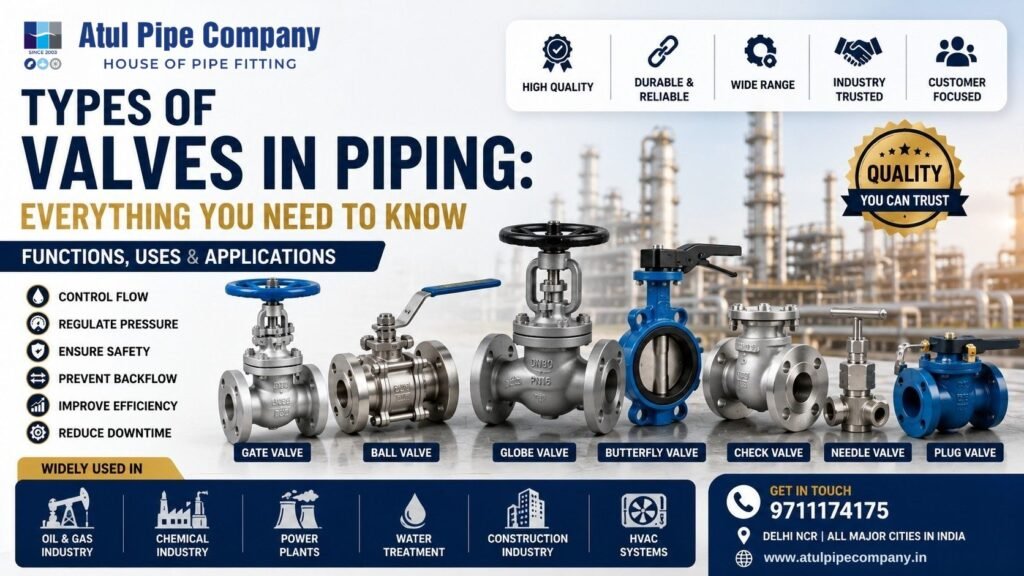
Valves are one of the most important components in any piping system. They control the flow of liquids, gases, and steam, helping industries operate safely and efficiently. Whether you are working on a manufacturing plant, water treatment facility, construction project, or oil refinery, selecting the right Types of Valves in Piping is essential.
Modern industries across Delhi NCR and India depend on high-quality industrial valves to improve performance, reduce downtime, and ensure safe operations. Every valve has a specific purpose, and choosing the correct one can significantly improve the life of your piping system.
At Atul Pipe Company, we work closely with engineers, contractors, builders, and industrial buyers who require reliable valve solutions. This guide explains different valve types, their functions, uses, benefits, and practical selection tips.
What Are Valves in Piping?
A valve is a mechanical device that controls, regulates, or stops the flow of liquids, gases, or steam through a pipeline. Valves improve safety, maintain pressure, and help industries manage fluid movement efficiently.
Types of Valves in Piping
Types of Valves in Piping are mechanical devices that regulate, stop, or direct the flow of fluids within a pipeline. Different valve types are designed for specific industrial applications based on pressure, temperature, and flow requirements.
Why Industrial Valves Are Important
Industrial valves help maintain safe and efficient piping systems.
Benefits of industrial valves
- Control fluid flow
- Regulate system pressure
- Prevent leakage
- Improve operational safety
- Simplify maintenance
- Increase pipeline efficiency
From our experience, selecting the correct valve reduces maintenance costs and improves the overall reliability of industrial systems.
Types of Valves in Piping
Different piping systems require different valve designs. Below are the most commonly used valve types.
1. Gate Valve
Gate valves are designed to completely start or stop fluid flow.
Best for
- Water supply pipelines
- Oil and gas systems
- Industrial plants
Advantages
- Low pressure loss
- Strong sealing
- Long service life
2. Ball Valve
Ball valves use a rotating ball with a hole through the center to control flow.
Applications
- Chemical industries
- Water treatment plants
- Gas pipelines
Benefits
- Quick operation
- Leak-proof sealing
- Easy maintenance
3. Globe Valve
Globe valves provide accurate flow regulation.
Common Uses
- Steam pipelines
- Chemical processing
- Cooling systems
Advantages
- Excellent flow control
- Reliable performance
4. Butterfly Valve
Butterfly valves use a rotating disc to regulate flow.
Applications
- HVAC systems
- Water distribution
- Large pipelines
Benefits
- Lightweight
- Compact design
- Cost-effective
5. Check Valve
Check valves allow flow in only one direction.
ak168win.vip AK168 – TRANG CHỦ AK168.COM – LINK VÀO AK168 MỚI NHẤT 2026 TẶNG 68K
Common Applications
- Pump systems
- Water treatment
- Industrial pipelines
Benefits
- Prevents backflow
- Protects pumps and equipment
6. Needle Valve
Needle valves provide precise flow adjustment.
Best For
- Laboratory systems
- Instrumentation
- High-precision applications
7. Plug Valve
Plug valves use a cylindrical or tapered plug.
Common Uses
- Chemical plants
- Oil processing
- Gas distribution
Advantages
- Quick shut-off
- Simple design
Valve Types Comparison Table
| Valve Type | Main Function | Best Application |
| Gate Valve | On/Off Control | Water & Oil Pipelines |
| Ball Valve | Fast Shut-off | Industrial Systems |
| Globe Valve | Flow Regulation | Steam & Chemicals |
| Butterfly Valve | Flow Control | HVAC & Water Plants |
| Check Valve | Prevent Backflow | Pump Systems |
| Needle Valve | Precision Control | Instrumentation |
| Plug Valve | Shut-off Control | Chemical Industry |
Industrial Valve Applications
Industrial valves are used in almost every sector.
Oil & Gas Industry
Control high-pressure pipelines and processing equipment.
Water Treatment Plants
Manage water flow and pressure.
Chemical Industries
Handle corrosive fluids safely.
Power Plants
Control steam and cooling systems.
Construction Projects
Used in plumbing, fire protection, and HVAC installations.
Across Delhi NCR, including Chandni Chowk, Noida, Gurugram, Faridabad, and Ghaziabad, industries depend on reliable valve systems every day.
How to Choose the Right Valve
Choosing the correct valve improves efficiency and reduces future maintenance.
Consider Pressure Rating
Ensure the valve matches system pressure.
Understand Fluid Type
Different fluids require different valve materials.
Check Temperature Conditions
High temperatures require specialized valves.
Select the Correct Size
Proper sizing prevents pressure loss.
Buy from Trusted Suppliers
Reliable suppliers provide tested, high-quality products.
At Atul Pipe Company, we recommend evaluating application requirements before selecting any valve type.
Practical Tips from Industry Experience
Here are some practical recommendations.
Inspect Valve Construction
Good finishing usually indicates better manufacturing quality.
Verify Material Grade
Material selection affects durability.
Request Quality Certifications
Certified products provide greater confidence.
Avoid Extremely Cheap Products
Low-cost valves often fail under demanding conditions.
Common Mistakes Buyers Should Avoid
Avoid these common purchasing errors.
- Choosing the wrong valve type
- Ignoring pressure ratings
- Selecting incorrect materials
- Purchasing uncertified products
- Focusing only on price
Preventing these mistakes improves long-term system performance.
Why Industries in Delhi NCR Choose Quality Industrial Valves
Industrial growth across Delhi NCR continues to increase the demand for dependable valve systems.
Quality valves help businesses:
- Improve productivity
- Reduce maintenance costs
- Prevent leakage
- Increase operational safety
- Extend equipment life
Whether the project is located in Chandni Chowk, Noida, Faridabad, or Gurugram, reliable valves remain a critical part of every industrial piping system.
Frequently Asked Questions
1. What are the main types of valves in piping?
The most common valve types include gate valves, ball valves, globe valves, butterfly valves, check valves, needle valves, and plug valves.
2. Which valve is best for industrial applications?
The best valve depends on pressure, temperature, and fluid type. Ball valves and gate valves are among the most commonly used industrial valves.
3. Why are industrial valves important?
Industrial valves control fluid flow, improve safety, regulate pressure, and protect equipment.
4. What is the purpose of a check valve?
A check valve prevents reverse flow and protects pumps and pipelines.
5. How do I choose the right valve?
Consider pressure, temperature, material, pipe size, and application before selecting a valve.
6. Where are industrial valves commonly used?
They are used in oil and gas, chemical processing, power plants, water treatment, HVAC, and construction projects.
7. Why choose Atul Pipe Company?
Atul Pipe Company offers dependable industrial valve solutions, quality products, and expert guidance for customers across Delhi NCR and India.
Conclusion
Understanding the different Types of Valves in Piping helps industries improve safety, efficiency, and long-term reliability. Every valve performs a specific function, and selecting the correct one ensures better performance with lower maintenance costs.
Whether your project involves water treatment, manufacturing, construction, or industrial processing, investing in high-quality industrial valves is essential.
At Atul Pipe Company, we are committed to supplying reliable valve solutions for customers across Delhi NCR and throughout India. Choosing the right valve today helps create safer and more efficient piping systems for years to come.