
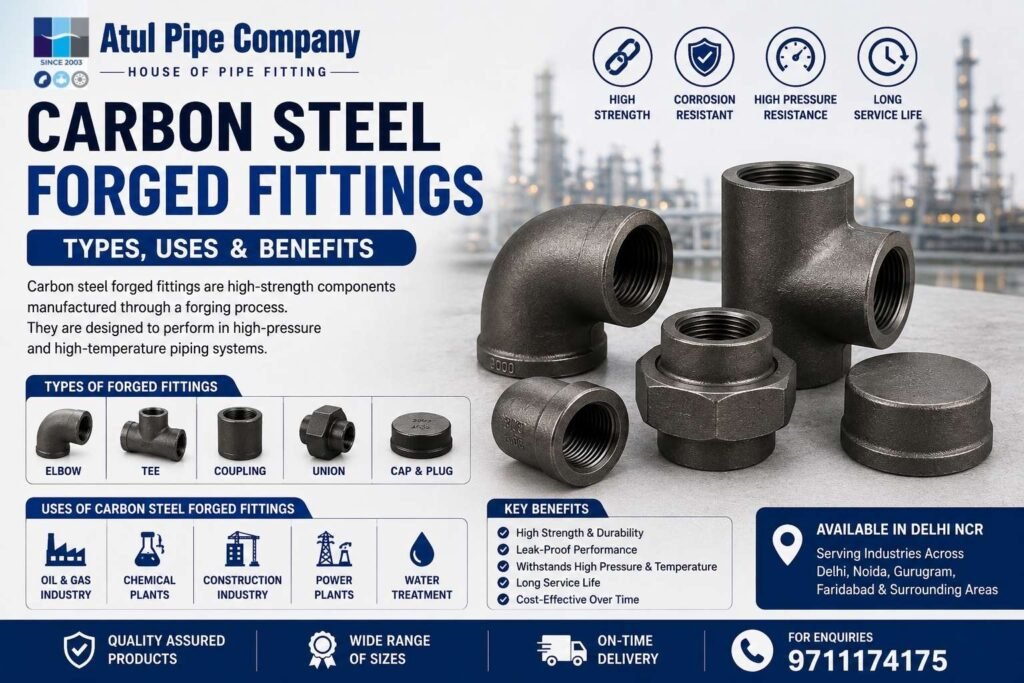
If you work in piping or industrial projects, you have likely heard about Carbon Steel Forged Fittings. These fittings are widely used in industries because of their strength, durability, and pressure-handling ability.
From factories in Delhi NCR to large industrial plants across India, forged fittings play a key role in safe piping systems. They are trusted in high-pressure and high-temperature environments where reliability matters most.
At Atul Pipe Company, we regularly supply forged fittings to contractors, industries, and infrastructure projects. In this guide, we will explain everything in simple language.
You will learn:
- What carbon steel forged fittings are
- Types of forged fittings in piping
- Uses and applications
- Benefits of forged fittings
- Tips for choosing the right fittings
What Are Carbon Steel Forged Fittings?
Carbon steel forged fittings are pipe fittings made through a forging process. In this process, heated carbon steel is shaped under high pressure. This makes the fittings stronger and more durable than regular cast fittings.
These fittings are mainly used for:
- High-pressure pipelines
- Industrial piping systems
- Oil and gas applications
- Chemical plants
Simple Answer
Carbon steel forged fittings are strong pipe fittings made by shaping heated carbon steel under pressure. They are used in high-pressure and industrial piping systems for secure and leak-proof connections.
Why Forged Fittings Are Important in Piping
In industrial systems, safety and durability matter a lot. Poor-quality fittings can cause leakage, pressure failure, or costly downtime.
Main reasons industries use forged fittings:
- High strength
- Better pressure resistance
- Long service life
- Reliable leak-proof performance
In our experience at Atul Pipe Company, forged fittings are preferred for critical projects because they handle stress better than ordinary fittings.
Types of Forged Fittings in Piping
There are different types of forged fittings in piping systems. Each fitting has a specific purpose.
1. Forged Elbow
Used to change the direction of flow.
Common angles:
- 45° elbow
- 90° elbow
Applications:
- Water pipelines
- Oil and gas systems
- Industrial process piping
2. Forged Tee
A tee fitting allows flow in multiple directions.
Types:
- Equal tee
- Reducing tee
Common uses:
- Branch connections
- Industrial fluid systems
3. Forged Coupling
Used to connect two pipes together securely.
Benefits:
- Strong joint
- Easy installation
- Leak-resistant connection
4. Forged Union
Unions allow easy assembly and removal of pipes.
Best for:
- Maintenance-friendly systems
- Frequent dismantling work
5. Forged Cap & Plug
These fittings close the ends of pipes.
Applications:
- Pressure testing
- Temporary shutdowns
- Safety sealing
Carbon Steel Forged Pipe Fittings vs Cast Fittings
Many buyers get confused between forged and cast fittings. Here is a simple comparison.
| Feature | Forged Fittings | Cast Fittings |
| Strength | Higher | Moderate |
| Pressure Handling | Excellent | Limited |
| Durability | Long-lasting | Average |
| Leak Resistance | Better | Moderate |
| Cost | Slightly Higher | Lower |
Practical Insight
For high-pressure industrial systems, forged fittings are usually the safer choice.
jin88.us.com Jin88 | Sân Chơi Uy Tín Thu Hút 1.000.000+ Hội Viên Tham Gia
Uses of Carbon Steel Forged Fittings
The uses of carbon steel forged fittings are wide across industries.
- Oil & Gas Industry
Used in high-pressure pipelines and refineries.
- Chemical Plants
Handle corrosive and high-temperature fluids.
- Construction Projects
Used in plumbing and industrial infrastructure.
- Power Plants
Reliable under extreme temperatures.
- Water Treatment Systems
Ensure secure flow control and connections.
Across Delhi NCR and Chandni Chowk industrial markets, forged fittings are in constant demand because of their reliability.
Benefits of Carbon Steel Forged Fittings
There are many reasons industries prefer forged fittings.
- High Strength
Forging improves the metal structure.
- Leak-Proof Performance
Ideal for pressure applications.
- Long Service Life
Reduces replacement and maintenance costs.
- Better Pressure Resistance
Suitable for heavy industrial systems.
- Cost-Effective Over Time
Long durability saves money in the long run.
How to Choose the Right Forged Fittings
Choosing the correct fitting is important for performance and safety.
- Check pressure rating
Always match the fitting with system pressure.
- Select proper size
Wrong sizing can cause leakage.
- Verify material grade
Quality carbon steel matters.
- Buy from trusted suppliers
Reliable suppliers ensure certified products.
At Atul Pipe Company, we always recommend checking specifications before purchase.
Common Mistakes Buyers Should Avoid
Even experienced buyers sometimes make mistakes.
Avoid these common errors:
- Buying only based on low price
- Ignoring pressure ratings
- Using wrong fitting type
- Choosing non-certified products
- Not checking compatibility
These mistakes can lead to expensive repairs later.
What are carbon steel forged fittings used for?
Carbon steel forged fittings are used in industrial piping systems to connect, control, or change pipe direction. They are ideal for high-pressure and high-temperature applications.
Why Industries in Delhi Prefer Forged Fittings
Industrial buyers in Delhi NCR prefer forged fittings because of their reliability. In areas like Chandni Chowk and Loha Mandi, industries often choose forged fittings for long-term projects.
The demand is high in:
- Manufacturing units
- Construction projects
- Chemical industries
- Oil and gas systems
FAQs
1. What are carbon steel forged fittings?
Carbon steel forged fittings are strong pipe fittings made using forged carbon steel for industrial piping systems.
2. What are the common types of forged fittings?
Elbows, tees, couplings, unions, caps, and plugs are common forged fittings.
3. Where are forged fittings used?
They are used in oil & gas, chemical plants, construction, and power industries.
4. Why are forged fittings better than cast fittings?
Forged fittings are stronger, more durable, and handle pressure better.
5. Are carbon steel forged fittings corrosion-resistant?
They offer moderate corrosion resistance and perform well in industrial environments.
6. How do I choose the right forged fitting?
Check pressure rating, size, material grade, and supplier quality before buying.
7. Are forged fittings suitable for high pressure?
Yes, forged fittings are widely used in high-pressure piping systems.
Conclusion
Now you clearly understand Carbon Steel Forged Fittings, their types, uses, and benefits. These fittings are an important part of industrial piping systems because they provide strength, durability, and safety.
Whether you are working on a factory project, pipeline system, or industrial setup, choosing the right forged fittings matters. At Atul Pipe Company, we focus on providing reliable products and practical support for industrial buyers across Delhi NCR and beyond. Choosing quality fittings today can save significant maintenance costs tomorrow.